I still haven’t figured out exactly what to post and not post on social media (and the blog). I probably never will. There’s a small group who have told me they enjoy the family stuff, and/or the music stuff, and/or the nostalgia. Because of the current situation in the country, I can’t stop myself from posting socio-political content occasionally, because things are so extremely messed up. Of course sometimes after a few days (or hours), I think, “I don’t like that post” and I delete it.
So I don’t know if this is appropriate and I don’t know if I’ll leave it or delete it.
Anyway, I’ve been in a battle most of my adult life with mental illness (to put it vaguely). There have been stretches when it was less of a battle; I was relatively healthy and happy, and I ‘made friends’ with my craziness. Conversely, there have been times when it was so brutal and maddening and excruciating, when I was in such a deeply miserable state, that it’s impossible to realistically represent it with a few words. It’s hell.
It’s also an ongoing dialogue with my doctor. I’ve tried prescription medication multiple times and it didn’t work (I know that many have benefited from these drugs, but I have not – net yet anyway). Like many in this situation, I’ve also self-medicated with various substances. That rarely works, as everyone knows (and “partying” looks pointless and stupid at this stage). I have a good brain; I’m creative, skilled, knowledgeable. But man can it go to dark and scary places. Call it cognitive chaos. Very few people understand it or know what to do, what to say, how to navigate it. Many simply disappear. “Harry’s too difficult” is a pretty common refrain. But one thing is certain: this kills people. No question. I’ve known a few, and I reached out and tried to help as much as I could.
Anyway, two points to wrap up this sunny Sunday ramble. 1) The good news about me is I’m a fighter and survivor. I recently turned 59 years old. Many with this kind of brain chemistry don’t make it to 59. But I get pissed off. I re-dedicate myself. I focus. I discuss it. I research and learn. I’m good to myself. Therapy has been extremely helpful. I get to work; keeping busy is crucial. And… usually things improve. It’s not easy and it won’t be moving forward. But I have faith in myself and in my (small) group of close friends. I’m grateful for my people. 2) If any of this feels familiar to you, know that you are not alone. You absolutely are not. It’s okay to be crazy. It’s okay to be angry. There are a lot of us out there, trying to act normal, trying to make money, trying to handle it, and gosh knows it can feel impossible. What’s most important is this IMHO: be good to you. Yell. Cry. Laugh. Eat healthy food. Take a nap. Dive deep into your work, whatever it is. Fill up the calendar – structure is good. Exercise. Listen to your favorite music – loud! Dance and shout and let it out. Don’t harm yourself or others. Find those trusted, wonderful people who love you, who get it, who want to help. Actively love them. Actively love yourself.
And if it feels like you don’t have anyone, I know the feeling. PM me. We’ll get on the phone and I promise, after honestly discussing it for a while, we’ll both be laughing. You know how this goes: we keep working our asses off, we celebrate the good days and fight through the bad ones, and we find the humor in the complicated, painful absurdity. No one said this would be easy. And the calvary is definitely not coming. But you can get through it. If I can, you can! I’m not especially strong. I just keep trying. This is a marathon, not a sprint, and the race ain’t over yet. hg
“My commitment is to strive to be worthy of the example of the great men who have gone before. Presidents walk in giant footsteps. They have magnificent legacies to uphold. I stand here on this day and put my name forth, as one who aspires to their example, who will daily make that sacrifice, who will honor not just the office, but the people that office serves. *Their* President of these United States of America.” — GOP Sen. Arnold Vinick, from The West Wing.
+ + +
I’ve recently returned to the show The West Wing. Generally speaking, it holds up well, mostly because Aaron Sorkin and John Wells are skilled craftsmen and the cast is strong. Sorkin’s writing can sometimes get too cute. I prefer serious Sorkin to goofy Sorkin. But it remains an intelligent, thought-provoking show. Of course, re-watching it now – in 2026 – is a different experience.
John Wells (who remained producer of the show through its seven seasons) has said the show emanated from Aaron Sorkin’s unused plot/story ideas for the film The American President. Because he had limited access to the president, Sorkin spent a lot of time with White House staffers. Sorkin and Wells aimed to create a realistic TV show about the daily lives of the staff; an ultra-qualified, conscientious, brilliant group of public servants dedicated to doing good work. Making a difference. Making the country better for every American. Their daily diligence and devotion to the rule of law offers a stark contrast to the Trump administration, which in many ways is the polar opposite, governing via fear, hatred, dishonesty, and ignorance. Bullying is celebrated. Compassion is mocked. Blind loyalty is essential. Expertise, science, democracy, laws and regulations…don’t matter. You know the drill. It’s not subtle.
Smart, Data-Driven Television About Smart, Data-Driven Work
We must remember that this is a television show. It’s melodramatic. It’s built to entertain, to make a profit, to make studio execs and advertisers happy. But it’s simultaneously produced by a creative team striving to make inspiring, empirical, authentic television, driven by constant input from advisors (from both democratic and republican administrations). They maintained a constant commitment to accuracy and detail. Here’s John Wells discussing the role of political consultants:
In his 2025 book Who Is Government?: The Untold Story of Public Service, Michael Lewis aims to show that the government is composed of very capable, motivated individuals whose work is often unnoticed and/or uncredited. He enlists other writers, including W. Kamau Bell, Geraldine Brooks, Dave Eggers, and Sarah Vowell, to profile these individuals. According to Lewis:
I didn’t set out to write positive stories about the federal government. I got interested in the first place when Trump fired his transition team right after he was elected the first time. And I learned that by law, the Obama administration was required to prepare for the transition and that there were a thousand people waiting to give briefings across the federal government. I thought it would be really cool to take a reader in and the reader would know, because no one showed up for the briefing, the reader knew more than the president did about how the government functioned. And indeed, I could do things like wander into the Energy Department and get the briefing about how the nuclear stockpile was managed and have them say, nobody’s come in to hear this before.
We don’t really know what our own government does. Even very intelligent, educated people. There was the famous government shutdown that lasted for a very long time. And the government furloughed 2/3 of its employees, describing them to themselves as inessential. And while working on the book, I had been struck by the quality of the people I was meeting. I wasn’t writing profiles. I was writing about what they were doing. But I just got kind of shocked by how mission-driven, committed, expert, definitely not lazy, definitely not abusive or fraudulent. I mean, wildly interesting people. And I thought, let’s just pick one of these characters and see how far you can go with it.
What also comes clear in the book is these workers tackle serious, complicated problems the private sector can’t handle. More importantly, he argues, they tackle problems that the private sector simply doesn’t care about. There’s no motivation to do the work if it doesn’t produce a significant profit. Lewis challenges the negative stereotypes of federal workers, calling the hatred of government workers, “the most sinister idea alive in this country right now.” They have each found a project that is their ‘calling’; it’s meaningful and important to them. They dig deep, find the problems, and make things better, and they’re not politicians. They don’t call attention to themselves. They’re not looking for fame or fortune. They just want to find the facts, solve problems, and make the country better.
These themes are central to the West Wing. While there’s more of a political component, you see similarly conscientious, focused individuals tirelessly striving to solve complicated issues, reflecting on the legality (and ethics) of every move. You see the heartbreaking sadness of war; when soldiers die the president and his staff feel the brutal weight of military decisions and the resulting, painful ripple effects through regions, communities, and families. The complexities of foreign policy are not ignored, nor is diplomacy immediately dismissed as too soft or weak. You see President Bartlett get angry when Americans are killed. His initial instinct is revenge, and there’s heated debate about the value of a “proportional response” to foreign aggression. (If they don’t care about civilian casualties, why should we?) Yet there is always a return to reasonable dialogue, to pragmatism, to broader historical and global context. They take a collective breath and strive to find the best decision (and in government ‘best decision’ never means ‘perfect decision’). There is a sunny, hopeful idealism to most of Sorkin’s writing. But he strives to balance this against the gray ubiquity of compromise, the brutality of history, and the discouraging mud of realism.
Compassion Is Not Weakness. Loyalty Is Not Always Good.
“The president likes smart people who disagree with him. He wants to hear from you. He’s asking you to serve. And everything else is crap.” – Chief of Staff Leo McGarry
+ + +
When is loyalty bad? There are countless examples. I’m guessing you’ve seen it. I certainly have. There’s a quote that says, “Loyalty itself isn’t the mistake – giving it to the wrong people is the mistake.” There’s pointed power in this idea. Why would you stay loyal to someone who continues to hurt you, who shows little remorse, who strives to normalize dishonesty, hate, and destructive aggression? Leo McGarry tells Aynsely Hayes that President Barlett wants her specifically because she is not loyal to the same ideology. She’s intelligent and experienced, and she has a different point of view. While Mr. Trump insists on a kind of extreme, mindless loyalty that is divorced from any critical thought or candor, the fictional President Bartlett insists on hearing from ‘smart people who disagree with him’. Why? Because the loyalty is to the American people – finding the best answers for the country, for most Americans. This goal is far more intricate and arduous than the simple Trump rule: do everything I say or else. Never question, never disagree.
The desire to do beneficial work, to make the world a better place, to serve the community, to empower the disadvantaged, to openly address privilege, to shine a spotlight on complex arguments (where both sides have valid, data-driven points); this mindset is dismissed instantaneously as “woke” or “radical left” by millions of Americans. Team Trump has done an excellent job of demonizing education, intellect, compassion, honesty, and integrity. All democrats are weak, out-of-touch, terrible people.
Yet these are some of the fundamental principles with which I’m raising my son. Of course you don’t back down from a fight – it can be a bloody, cruel world – but you lead with love, intelligence, and empathy. I’ve never been scared of MAGA’s loud, enraged posturing. I’ve heard it all (or most of it) before. However, now that they inhabit positions of national, public, political power, I am definitely scared of their collective ignorance, fear, and seething hatred. This is where the real, lasting destruction germinates (as we’re witnessing).
Also, isn’t this completely obvious? The political impact of MAGA is clearly seen in this simple fact: trying to be an informed, conscientious person is now under attack. Raising your kids the right way is somehow weak and unacceptable. The moral and ethical foundation has been rocked and many of us feel it every day. This dissonance is continually re-established, as media outlets normalize and legitimize the same MAGA crap. I’m aware that many of the mechanisms behind these changes (which have recently become more public and obvious) have existed in the dark for a long time. They’re purposefully hidden. Most billionaires don’t care about the country. Corporations are NOT people even if the law says they are (and if corporations are ‘people’, they are psychotic people). In many ways the only difference is that more of us are now acutely aware of the destructive and vile powers behind closed doors. So one question (of many) is: can we do anything to make a lasting change?
The undeniable truth: this can’t only be about greed and profits and getting rich. With the impact of MAGA, that might sound absurd in 2026. But the fact is, if we’re going to be okay as a planet, the most constructive and sensible agenda cannot be about corporate greed and demonizing/hating minorities, distracting technology and manipulative media and toxic markets. There must be another set of priorities. By definition, this is not a liberal or conservative viewpoint. It is science-based fact.
Let’s celebrate work for the common, global good. While life is rarely as poetic or clever or perfectly structured as a Sorkin script (there’s a lot of raw, chaotic, exhausted ugliness too), I’ll stay committed to said endeavor. Sorkin called the West Wing a “love letter to public service.” It’s enlivening and comforting to re-read this letter in the era of MAGA, even as we all know it’s hopelessly romantic. “Hopeless romanticism” – tempered by all the facts – could be a useful blueprint for a better life for you and yours, and for the planet. Love to all, hg
I want to write about sandwiches. Thank the Good Lord for John Montagu (18th Century Brit), AKA The Earl of Sandwich, who was so impatient during his frequent gambling sessions that he insisted on having his roast beef between two slices of bread, so he could stay in his chair.
In my insomnia-driven video explorations, I find myself watching many things including highlights from late-night TV. I discovered that Stephen Colbert has something called the “Colbert Questionnaire” and his first question is, “What is the best sandwich?” It’s a deeply revealing way to start a list of personal questions. It launched my brain into racing, sandwich-tastic thoughts far and wide. I love sandwiches so much – as a category – that I could never choose just one. So, in no particular order, here are a few thoughts regarding the outstanding sandwiches of my life:
1) I begin with the chopped beef sandwich from Bert’s in Austin. Sure, the list of delectable barbeque sandwiches is long (and debated). Yes, the original location doesn’t exist any more (burned down). I don’t care. I remember the aroma in the parking lot on MLK Blvd, leading to this perfect sandwich: wonderfully small and easy-to-scarf barbeque beef chopped into an even consistency with a sweet and tangy sauce, on a simple white bun, with pickles. I usually had two, with a Dr. Pepper. Texas comfort-food bliss with old Longhorn friends.
2) Pastrami Queen in NYC. I initially went for one reason: it was an Anthony Bourdain favorite. And I’m so happy I did. Katz’s is the more famous destination and it’s sensational, but I prefer the Queen. It’s really all about that other-wordly, crazy-flavorful, moist and tender pastrami.
3) The “Special Italian” hoagie from Carlino’s Italian Market here in Ardmore, PA is strong. Like barbeque in Texas, the topic of sandwiches in PA – hoagies, cheesesteaks – can get contentious, even violent. I’m going with Carlino’s. One essential consideration when thinking about a sandwich: the amount of each ingredient. Too much bread? Sandwich too dry. Too much condiment? Sandwich too wet. The combination of flavors and textures must be just right. Carlino’s nails it consistently. Oliver enthusiastically agrees.
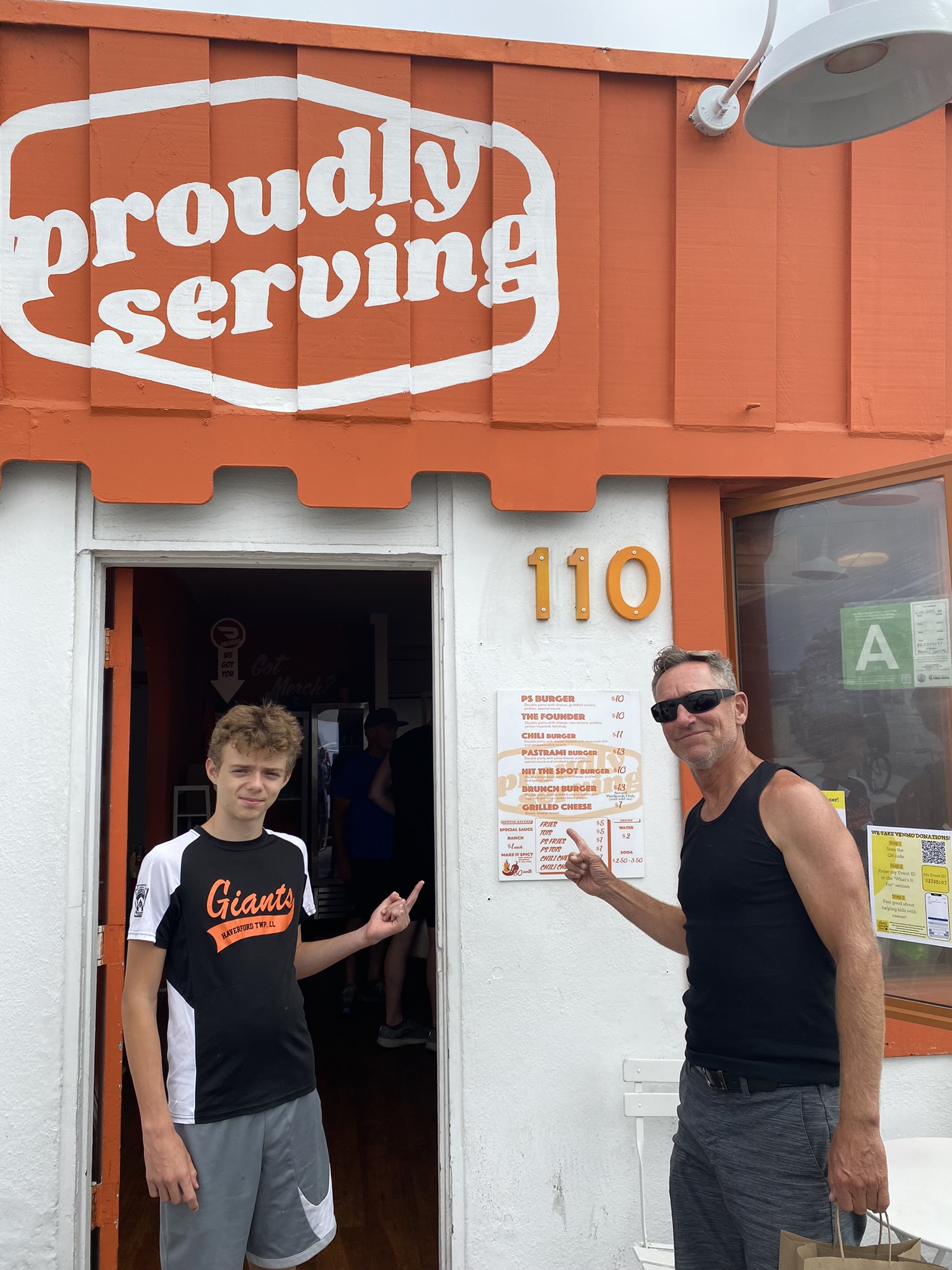
4) My numero uno burger is from a place called Proudly Serving in Hermosa Beach, CA. My brother Jeff Atkinson took me and Oliver (Jeff’s awesome daughter Lucy works there). These are smash burgers; medium-sized, gigantic flavor, ultra-fresh ingredients, perfectly seasoned. My choice is The Founder (w/jalapenos added and plenty of PS special sauce).
5) Is a hot dog a sandwich? I say, “well of course it is.” My favorite hot dog place is Pink’s in LA. Of course Pink’s is old and famous, a beloved local legend. Walls covered with signed movie star pics, lines down the block. My fave at Pink’s? Tough question, but I will go with the spicy El Cucuy Dog. By the way, a close second place in the hot dog category goes to Lucky’s Last Chance in Manayunk, PA, much-loved by son and wife as well.
6) Additional quick thoughts: a) In the unique and delicious city of New Orleans, it’s the fried oyster po-boy from Parkway Bakery, with the exactly-right amount of each ingredient and perfectly fried oysters. b) Bahn Mi anyone? My fave is probably from Anh Hong Pho Cafe here in Philly, Upper Darby, not far from our house. Cost? Four bucks! (Yes, it’s the spectacular deal of the list.) c) The Cuban sandwich at Le Segunda Central Bakery, Tampa, is dreamy. Twas introduced to me and my dad long ago (by my brother-in-law at the time) in an authentic, tiny hole in the wall near Raymond James Stadium. This sandwich changed my life. d) The family was recently in Montreal, so I should include the world-famous smoked meat sandwich from Schwartz’s Deli: some of the most delicious smoky juicy tender meat you’ll find anywhere. e) Finally, from Antone’s in my home town of Houston, I must include the “Original” po-boy. This was a beloved childhood treat and a joyful weekend excursion for me, my sister, and my dad. Sandwich nostalgia at its most savory.
What are your favorite sandwiches?! Please chime in – I’m always eager to eat more. Enjoy! Love, hg
I must chime in on this. Throughout my life I’ve argued against the ‘dumb jock’ narrative, as I’ve met some of the smartest people I’ve ever known through sports (specifically running). Obviously there are plenty of intelligent people out there who are/were elite athletes, as well as former coaches, sports commentators, journalists, and fans who are perceptive, fair-minded, and erudite. But a lot of the dialogue around Arch Manning is just fucking stupid.
First, yes, the internet is overly-democratized. We know this. Every voice is presented in a way that’s seemingly equal: someone who’s studied a disease his/her entire life can be viciously provoked by someone who ‘saw a thing on Fox News’, and if this scientist makes reference to the decades of hard work he/she put in, they’re immediately dismissed as ‘woke’. It’s toxic and destructive, depressing and moronic, but that’s life in 2025. If I want to challenge John McEnroe on a fine point of tennis technique, my argument is just as valid as his. I will loudly and arrogantly declare myself the debate champion and a tennis expert (note: actual expertise not required).
Additionally, ESPN has signaled to all of us that a particular type of simplistic, shock-value ranting is preferred above fact-driven, experienced commentary. Who’s the tough guy – in his muscle shirt – regularly making dumb, cocky comments? He was a kicker, right? You’re on TV – put on a dress shirt and blazer you dipshit.
On social media the posts re: Texas football are about as poisonous as they come. The trolls are pervasive and nasty. As far as I can tell these are some of the most disgusting humans out there, as they’re often attacking teenagers, who happen to be incredibly good at football but are clearly inexperienced, and trying to figure it out, and thrust on to a public platform they’re not quite prepared for.
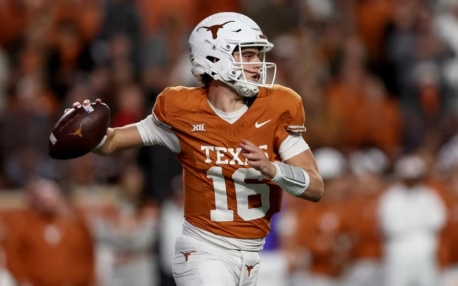
Arch Manning, I would argue, is prepared. I’ve researched him, specifically learning about his family and upbringing. I’ve watched and read interviews with him. Remember: Arch’s parents weren’t superstars. They were both excellent athletes, but they’ve never been famous in the way his uncles and grandfather are. He grew up in a pretty normal household, he works hard, he depends on his friends and family, and he “just loves to ball” as he often says. He seems to strike that unusual and ideal balance of self-confidence and humility, and he holds himself accountable. He knows he hasn’t done anything yet. The hype machine will roll along in whatever crazy direction it does; he’s eager to learn, lead the Longhorns, and win football games.
That didn’t happen on Saturday and, generally speaking, he played poorly. He was the first one to admit it. Sark’s job is different – part of his role is to spin things a bit, and he did, while acknowledging that Arch was pressing and looked uncomfortable. Also, Sark rightly pointed out that Ohio State is wildly talented and their (NFL-veteran) defensive coordinator threw some coverages and schemes at Arch that he struggled with. I thought he made some nifty runs, and exceptional throws, in the second half. But it was too little too late. Texas loses.
So as fans, as onlookers, what do we say? Frustrating loss? Of course. Does Arch need to play better? Yep. Is part of this on the coaching staff? You bet it is. As Sark said, this was the first chapter of a (long) book. Sark also said Texas would do a lot of “internal focus” this week, which makes sense.
So who says it’s okay to heartlessly attack this kid? What’s the thought process? And even more to the point, how idiotic do you have to be to declare Manning a failure and the Texas season over after one game? The college football season is very long. Did you notice? Put the two together – hatefully attacking the young player and making broad melodramatic statements about the future of Texas football – and you have a special kind of jackass. Arch Manning is prepared for this. The reason I know this is because of the way he handled the aftermath, the way he discussed it; he shouldered the blame and insisted that he must get back to work and improve. He did this in the same measured, cool-as-a-cucumber way he does everything. When the Heisman hype is deafening, he’s steady. When the criticism is mean-spirited and brainless, he’s steady. I think Arch Manning is going to be just fine. The college football trolls? No one actually cares what they think or do, because there’s no reason to.
Thanks for reading my little Wednesday vent. Hook ‘em. hg
I just had one of the most emotional reactions to music I’ve ever had. It was at the Church of St. Andrew and St. Paul near our hotel here in downtown Montreal. I strolled into the cathedral and the choir was rehearsing: one solo, tenor voice over the chorus, who were singing the chord movement behind him. It was a simple arrangement, perfectly performed, but more than reflecting on anything technical or specifically musical, I was overwhelmed with a pure emotional reaction to the sound. This was direct, immediate, heart-felt impact. These slowly floating, heavenly voices consumed me. I wasn’t sure what to think because it’s been a long time since I felt this. The perfect resonance of the hall (the best reverb ever!) contributed too, of course.
Whatever your feelings about God or organized religion, one truth is immutable and undeniable: much of the most powerful, sublime, effectual artistic expression in the history of mankind has been made in service to God. This transcends denomination, region, or time period. It can be Catholic or Muslim or Jewish (or tied to any other religion). Very often it will surprise you and it will bring you to your knees. It will elicit revelatory wonder.
To walk into a majestic and magnificent old cathedral and be instantly driven to tears by sheer, uncontaminated musical beauty…this doesn’t happen every day. I’m grateful to God, to the musicians, to the composer, to the church. After all these years, in this often heartless, brutal, dishonest, money-obsessed world of 2025, the deep truth of music can still pull me in and blow me away. Amen. hg
Howdy folks. I’m starting this new phase with a blog post and it’s a fun one. Here are fifteen of my favorite (pop/rock) songs from 1969. It was the year of Woodstock (fun!) and Altamont (not fun!), the first lunar landing and the first episode of Sesame Street, the Stonewall Riots and the inauguration of Richard Nixon. Some say the sixties ended abruptly on August 10th, with the gruesome Tate-LaBianca murders. But I promised fun! And these songs deliver, from the groovy beauty of Stevie Wonder to the glorious early-punk thrashing of the Stooges, from the deep swampy pocket of the Meters to the swinging melancholy of Nick Drake, this list has it all. Note: I did not include songs by Joni, Beatles, Who, or Zeppelin – I like them too much, or something. So, in no particular order, here are my favorite fifteen songs from 1969. Find them, listen to them, and don’t be afraid to dance!
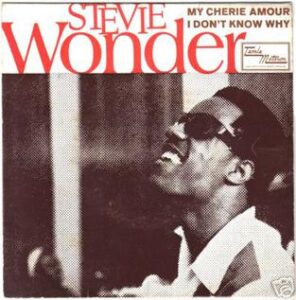
“My Cherie Amour” – Stevie Wonder
“Hot Fun in the Summertime” – Sly and the Family Stone
“Spinning Wheel” – Blood, Sweat, and Tears
“This Girl’s in Love with You” – Dionne Warwick
“Everybody’s Talkin’” – Harry Nilsson
“Galveston” – Glen Campbell
“Cissy Strut” – The Meters
“Lay Lady Lay” – Bob Dylan
“Israelites” – Desmond Dekker and the Aces
“I Wanna Be Your Dog” – The Stooges
“Can’t Find my Way Home” – Blind Faith
“Son of a Preacher Man” – Dusty Springfield
“River Man” – Nick Drake
“Everybody Knows This is Nowhere” – Neil Young
“Something in the Air” – Thunderclap Newman
Finally, here’s me (below) with a quick basement cover of the Blind Faith tune from back in 2014. Take care everybody.